


Transparent Conductive Polymer Boosts Bifacial Solar Cells, Unlocking More Efficient Ambient Light Harvesting
 18 November 2026 04:43 PM
Summary: Researchers at DGIST have developed a DMSO-engineered transparent conductive polymer back electrode for antimony-based solar cells, enabling efficient bifacial power generation and four-terminal tandem integration. The technology achieves a 12.32% power conversion efficiency in tandem devices and offers a promising approach to harvesting reflected and scattered sunlight.
To increase solar power generation, solar cells must capture not only direct sunlight but also reflected and scattered light from the ground and surrounding objects. Bifacial and tandem solar cells are emerging as important next-generation photovoltaic technologies. Bifacial cells can absorb sunlight from both the front and rear surfaces, while tandem cells stack two sub-cells with different spectral responses to improve overall power conversion efficiency.
However, achieving high-performance bifacial solar cells requires the development of advanced transparent back electrodes. These electrodes must simultaneously provide high optical transparency and efficient electrical conductivity, making it difficult to balance the two properties. A research team led by Professor Hwang Dae-kyu and Professor Kim Dae-hwan from the Department of Energy and Environmental Technology at Daegu Gyeongbuk Institute of Science and Technology (DGIST) has developed a new transparent back-electrode architecture using solution-processed multilayer conductive polymers. By introducing dimethyl sulfoxide (DMSO) as an additive into the conductive polymer, the researchers precisely tuned its electrical conductivity. This approach reduced the resistance that impedes charge transport by four orders of magnitude while maintaining high optical transparency.
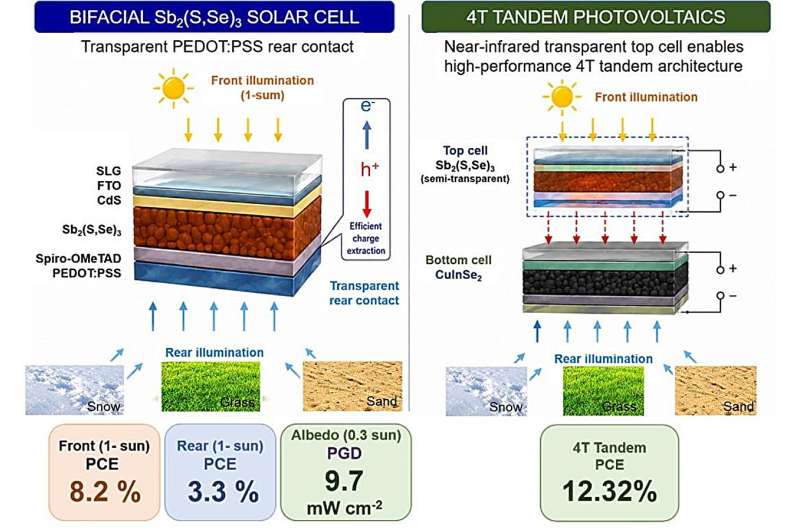
Using the new back electrode, the team fabricated bifacial antimony-based solar cells that achieved a power conversion efficiency of 8.2% under front-side illumination and 3.3% under rear-side illumination. The researchers then developed a four-terminal tandem configuration, using an antimony-based solar cell as the top cell and a CuInSe₂ bottom cell with complementary spectral absorption characteristics. The two sub-cells absorb different portions of the solar spectrum, allowing them to work together more effectively. The resulting tandem device achieved an overall power conversion efficiency of 12.32%.
Under simultaneous illumination of both the front and rear surfaces at an intensity equivalent to one sun, the tandem device delivered a bifacial power density of 18.81 mW/cm². This result demonstrates the device's ability to effectively capture ambient reflected and scattered sunlight and convert it into electrical energy.
The research team stated that the study confirms the feasibility of using antimony-based solar cells for bifacial power generation and demonstrates the potential of the newly developed transparent conductive polymer back electrode to support the integration of antimony-based cells into tandem photovoltaic systems. Future work will focus on optimizing the interface between the electrode and light-absorbing layer, as well as refining the optical structure to further improve solar cell performance. The research findings have been published in the journal Advanced Materials.