


MIT Flapping‑Wing Microrobot Flies and Lands on Sunflower With Onboard Sensing and Computing
 19 November 2026 05:10 PM
Abstract:MIT researchers built an insect-scale flapping-wing microrobot equipped with its own sensors and microcontroller, enabling trajectory tracking and precision landing on a sunflower without relying on lab motion-capture cameras. Though still tethered for power, the work marks the first sensory-computing autonomous flight demonstration of this type of tiny aerial robot, opening pathways for robotic pollination, crop monitoring and industrial inspection. The findings are published in Science Robotics.
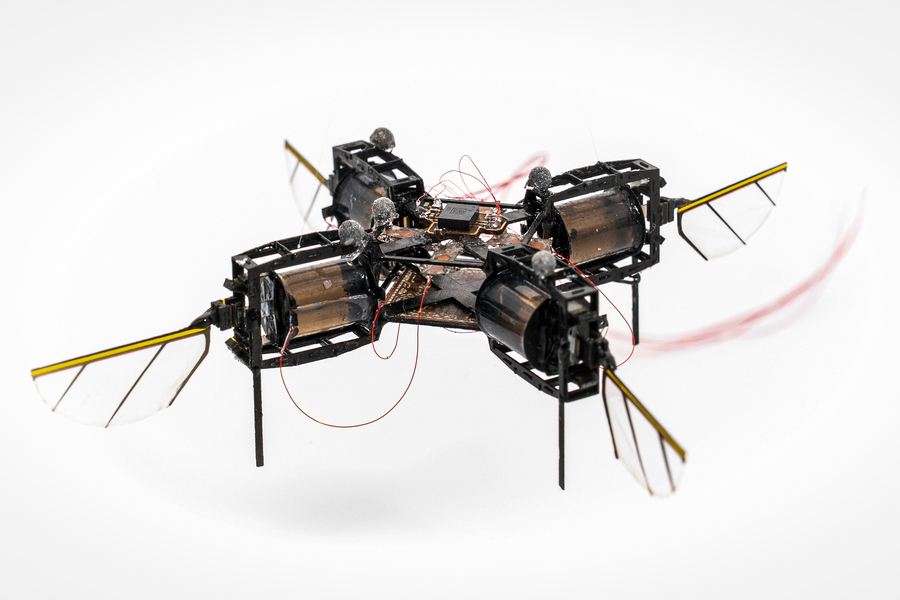
MIT researchers have developed a lightweight flapping-wing microrobot that can sense, compute and fly independently of external motion-capture systems, completing controlled flight and landing on a sunflower in open test space.
For years, MIT’s bee-like tiny aerial robots were limited to lab environments, because they lacked enough payload to carry navigation electronics and required external camera tracking. To solve this payload bottleneck, the team redesigned the soft artificial muscles that drive the robot’s wings. By tuning the geometry of actuators, they enlarged the artificial muscles by 50% and boosted lift by 46%, reaching a lift-to-weight ratio of 1.9. This extra lift supports a 244 mg onboard electronics stack, packed with an inertial measurement unit, optical flow sensor, time-of-flight sensor and microcontroller.
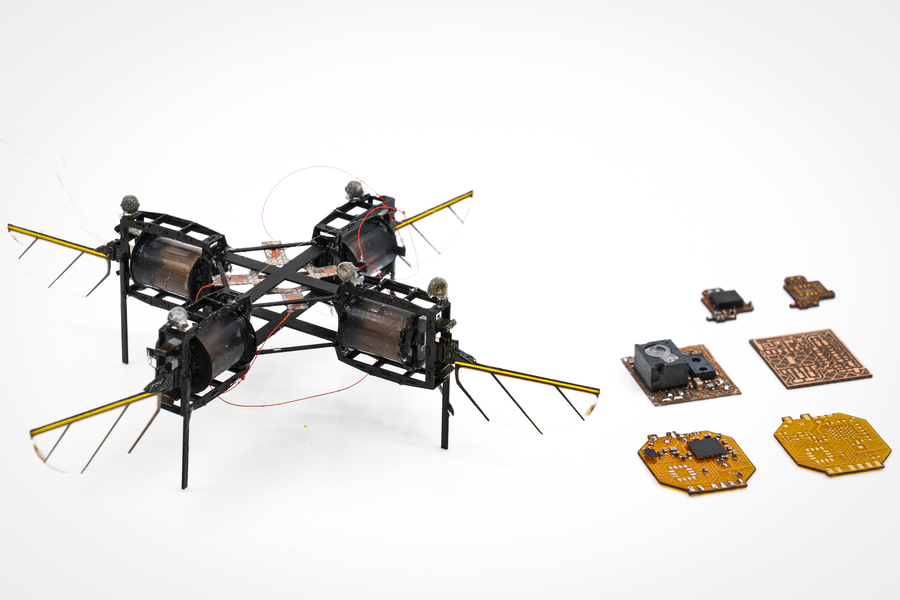
The robot is about the size of a microcassette and lighter than a paperclip. Without motion-capture reference, position drift becomes a key challenge. The research team created a fast, low-computation sensing algorithm to estimate orientation, velocity and position. Tests show faster continuous position estimation delivers better flight stability than slower, higher-precision calculation. The electronics package is fixed on a fiberglass substrate to resist vibration during flapping flight.
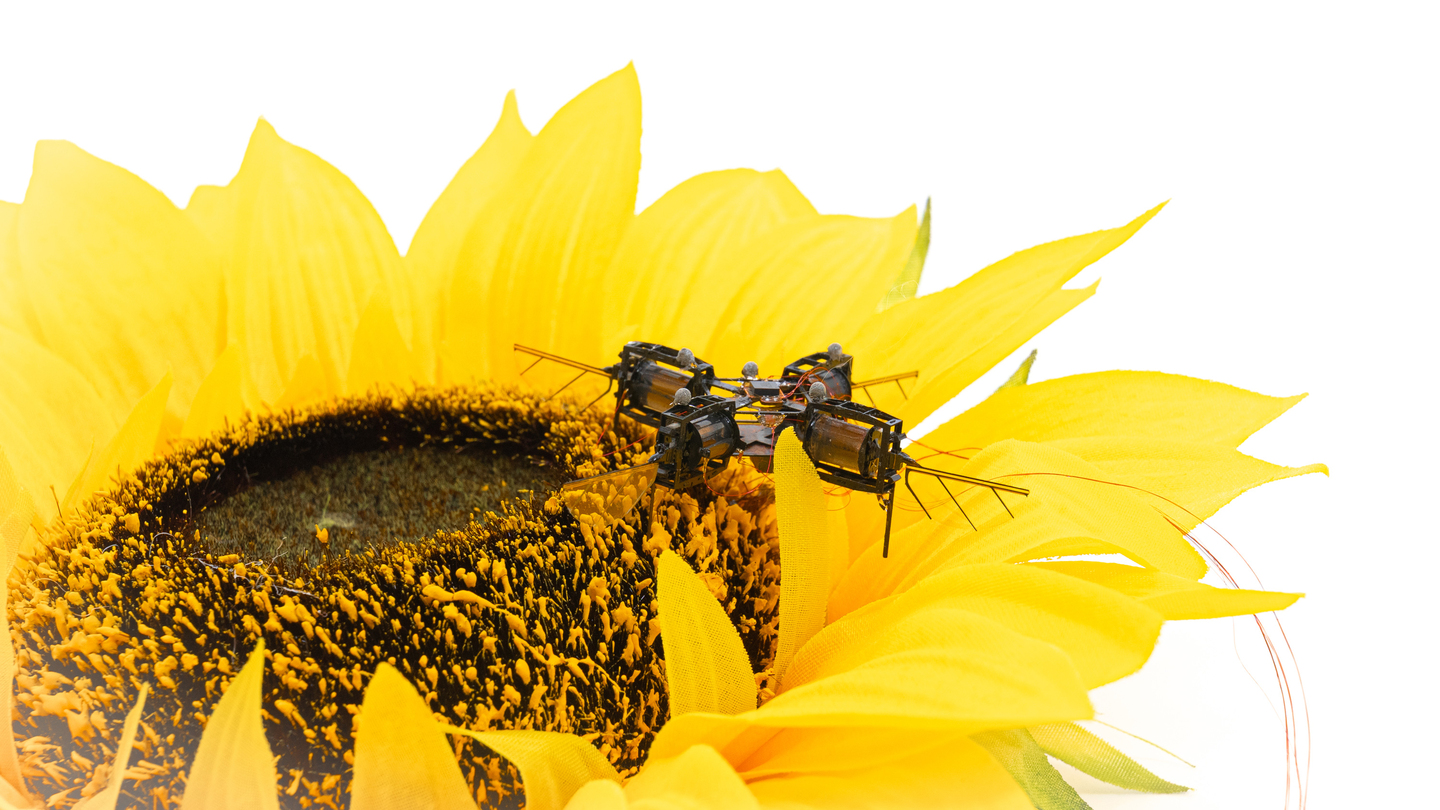
Flight trials prove the robot can hover at different heights and follow planned paths with positioning errors of only a few centimeters. In one landmark demonstration, operators sent high-level navigation commands, guiding the microrobot around plants before it landed precisely on a sunflower, showing promise for artificial pollination.
“This is a really important milestone for the research community. This is the first demonstration of an aerial microrobot that is sensory and compute autonomous. There are many situations, like pollination or industrial surveillance, where you can’t use a larger robot. Small-scale robots are uniquely positioned for these types of tasks, and if this thread of technology becomes successful in the future, it could be very promising,” said Kevin Chen, associate professor at MIT EECS and co-corresponding author of the paper.
Power analysis reveals the sensing and computing hardware only consumes roughly 6% of the robot’s total power budget; most energy goes into the flapping actuators. The team notes there is room to cut electronic power draw, which may allow adding vision hardware for object recognition.
The next development targets include integrating an onboard camera for autonomous obstacle avoidance and object identification, plus built-in batteries to eliminate the power tether and achieve fully untethered outdoor flight. The research was funded by the NSF, Office of Naval Research, Air Force Office of Scientific Research, MathWorks and the Zakhartchenko Fellowship.