


Summary: Researchers at the University of Pennsylvania have developed CoilLCE, a new type of artificial muscle that combines liquid crystal elastomers, graphene and embedded copper coils to enable self-sensing, closed-loop control and coordinated movement. Demonstrated in robotic fingers playing piano and biomimetic eyes tracking different directions, the technology could advance soft robotics, humanoid robots and expressive robotic faces.
Inspired by the Small Muscles of the Human Body
Can robots reproduce the delicate movements of human fingers and eyes? Engineers at the University of Pennsylvania (Penn) have developed a new artificial muscle system designed to bring robotic movement closer to biological precision.
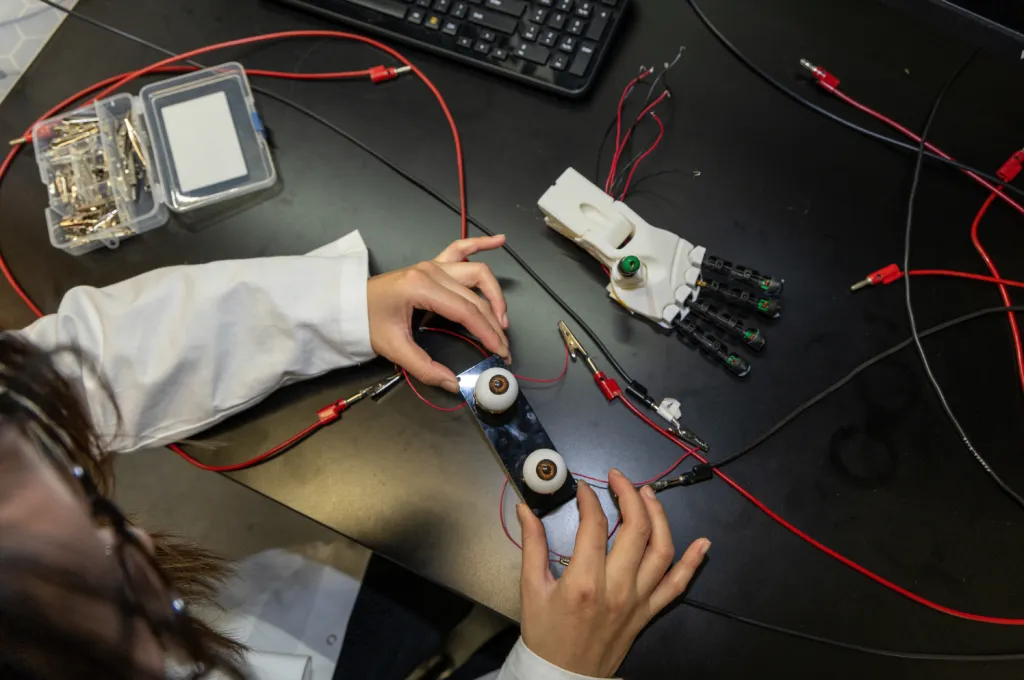
Led by Shu Yang, Joseph Bordogna Professor of Materials Science and Engineering, and Cynthia Sung, Associate Professor of Mechanical Engineering and Applied Mechanics, the research team developed artificial muscles inspired by the small muscles responsible for fine movements in human hands and eyes.
The findings, published in Advanced Functional Materials, introduce CoilLCE, a flexible artificial muscle designed to sense its own state, maintain intermediate positions and coordinate movements with other actuators.
CoilLCE Combines Actuation and Sensing
CoilLCE fibers are made by combining liquid crystal elastomers (LCEs), graphene and an embedded ultrathin copper coil.
Each component serves a specific purpose. LCEs change shape when heated, generating the contraction needed for movement. Graphene improves the material's flexibility and toughness, allowing the artificial muscle to stretch and withstand mechanical forces.
The embedded copper coil performs two functions simultaneously: it acts as a heating element and a sensor.
When electrical current passes through the coil, the resulting heat triggers muscle contraction. At the same time, changes in the coil's electrical resistance provide information about the muscle's movement and condition.
Using this resistance signal as feedback, the researchers can adjust heating power in real time. This closed-loop control enables the artificial muscle to maintain intermediate contraction levels for extended periods, overcoming a key challenge of conventional liquid crystal elastomer actuators.
Importantly, the integrated design eliminates the need for a separate feedback sensor, potentially simplifying soft robotic systems.
Coordinated Artificial Muscles Enable More Natural Movement
To demonstrate the technology, the team built robotic fingers capable of pressing piano keys and biomimetic eyes driven by four pairs of opposing artificial muscles.
The system reproduces the operating principle of biological muscles: when one muscle contracts, its opposing muscle stretches, enabling controlled and coordinated movement. This arrangement can also reduce the number of independent control inputs required.
The approach could have significant implications for humanoid robotics, particularly the development of expressive robotic faces. By integrating numerous miniature artificial muscles into limited spaces, future robots could reproduce subtle facial movements and more natural expressions.
The research team plans to explore artificial intelligence and computer vision to coordinate increasingly complex artificial muscle systems.
By combining flexible materials, integrated sensing and closed-loop control, CoilLCE represents a promising development in soft robotics, bio-inspired actuators and artificial muscle technology. The approach could help bridge the gap between conventional robotic mechanisms and the fine motor capabilities of biological systems.

