


Summary: Researchers have developed an event-driven neuromorphic vision sensor using an organic mixed ionic-electronic conductor (OMIEC), enabling programmable visual gain control within a single active layer. The device combines light-triggered electrical pulses with ion-mediated suppression, achieving * accuracy in human action recognition with just 0.064 mJ of front-end energy.
A New Approach to Neuromorphic Vision
Conventional image sensors capture entire frames, generating redundant data and consuming substantial processing energy. Event cameras reduce this burden by detecting changes in light intensity, but typically lack programmable control over signal amplification.
Inspired by the human retina, researchers have developed an ion-electron coupled event-driven optoelectronic sensor (IEES) that combines temporal contrast detection with voltage-programmable pulse-amplitude modulation.
Published in a Nature journal, the study introduces a material-based approach to artificial visual attention, allowing sensors to selectively enhance or suppress visual signals.
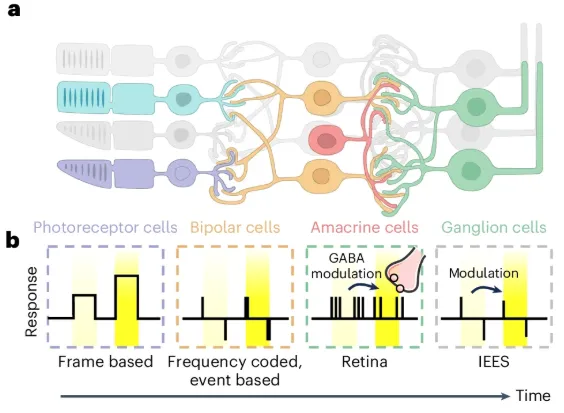
Comparison of frame-based, event-based, biological retinal and IEES vision processing
Organic Materials Enable Built-In Signal Control
The device uses a 130-nanometer-thick bulk heterojunction film made from PgBDT-T, an organic mixed ionic-electronic conductor, and Y6, a non-fullerene electron acceptor. An ultrathin electrode-based architecture connects the active layer to an electrolyte.
Under illumination, rapid electron extraction through Y6 generates an excitatory photocurrent pulse. Meanwhile, slower hole transport in PgBDT-T causes positive charge accumulation. Electrolyte anions compensate for this charge, weakening the local extraction field and increasing charge recombination.
This creates an inhibitory feedback mechanism that suppresses subsequent photocurrent.
By adjusting the applied voltage, the device can program signal amplitude, effectively reproducing an attention-like gain control mechanism within the sensor itself.
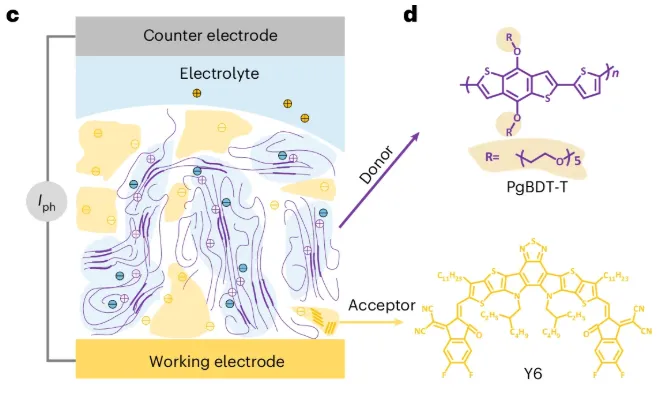
IEES device architecture and ion transport
Programmable Visual Attention at the Pixel Level
The IEES demonstrates a dynamic range exceeding 75 dB and detects light changes as low as 0.055 mW/cm². It also responds across visible and near-infrared wavelengths, from 455 to 850 nm.
In a 4 × 4 pixel array, researchers demonstrated spatially programmable visual attention by applying different voltages to individual pixels, selectively adjusting their response amplitudes.
The approach was further tested using 128 × 128 video sequences featuring human movements. By assigning different voltage levels to different subjects, the sensor selectively enhanced one person's motion signals while suppressing others.
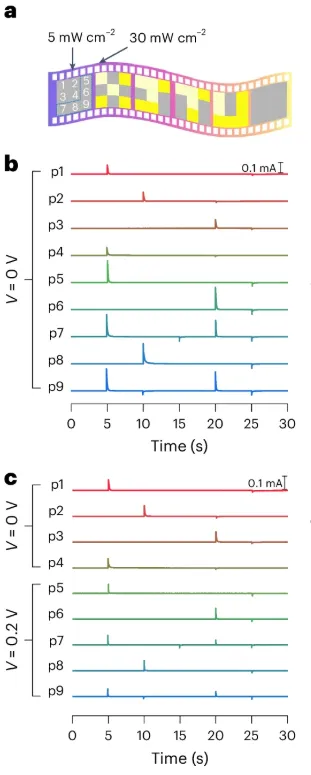
Pixel-level voltage programming and visual attention demonstration
* Recognition Accuracy with 0.064 mJ
To evaluate system-level performance, the team developed an IEES-based hybrid amplitude-temporal coding neural network (IEES-HATC NN).
Tested on four human actions—walking, running, jumping and jumping jacks—the system achieved * classification accuracy, compared with 94.2% for a frame-based neural network and 75.8% for an event-camera-based network.
Its front-end energy consumption was just 0.064 mJ, substantially below the 0.69 J and 2.80 J required by the event-camera and frame-based approaches, respectively, under matched benchmark conditions.
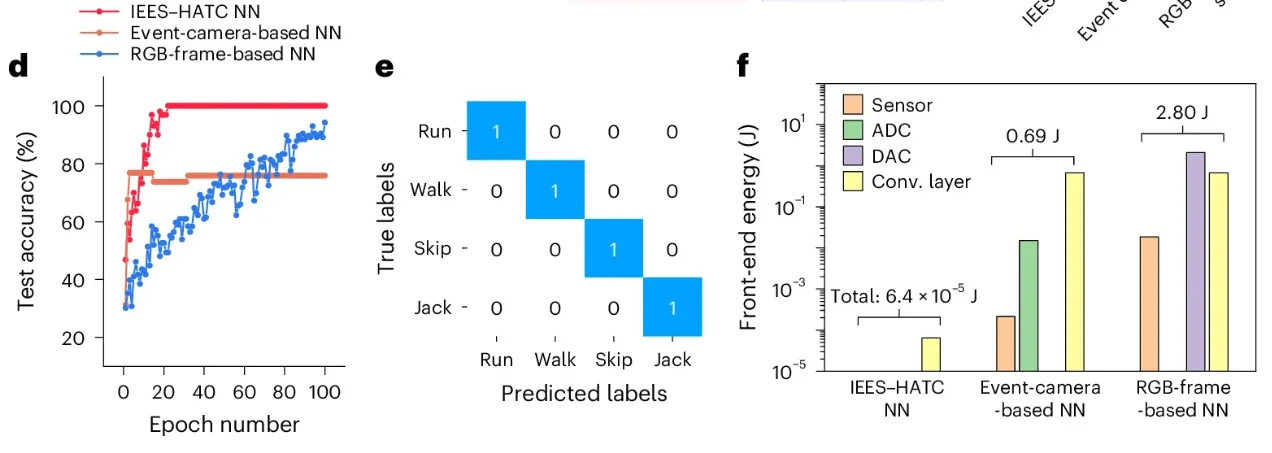
Action recognition accuracy, confusion matrix and front-end energy comparison
Toward Low-Power Intelligent Vision
By integrating event detection, ionic feedback and programmable signal amplification into a single organic active layer, IEES offers a new materials strategy for neuromorphic vision hardware.
The technology could support energy-efficient machine vision, edge AI, autonomous systems and intelligent robotic perception, where sensors need to process relevant visual information without continuously transmitting large volumes of redundant image data.

