


Summary: Researchers have developed a flexible reflective display that simultaneously presents visible-color information for humans and near-infrared (NIR) patterns for machine vision systems. Based on a single electrochromic PEDOT active layer, the technology could improve human-robot collaboration and enable next-generation smart factory labels and flexible industrial interfaces.
As smart factories increasingly integrate industrial robots, AI-powered automation, and human workers, reliable information exchange between people and machines is becoming increasingly important. Conventional visual labels rely on visible light and can become difficult to read in low-light, dusty, or foggy environments.
To address this challenge, researchers have developed a single-chip flexible display that supports two optical communication channels. It uses conductive polymer PEDOT as its sole active electrochromic layer, combined with a multilayer thin-film reflective optical structure.
When an electrical voltage is applied, PEDOT changes its light absorption characteristics. Increased absorption makes the display darker, while reduced absorption increases reflection and brightness. The integrated optical structure extends this modulation to the near-infrared spectrum, allowing the same pixel to deliver visible colors for human observation and NIR patterns detectable by specialized cameras.
The researchers demonstrated a 4 × 4 prototype with 16 independently controlled pixels, each addressed by a thin-film transistor (TFT). A gel electrolyte reduces leakage risks, while a flexible substrate allows the device to conform to curved surfaces.
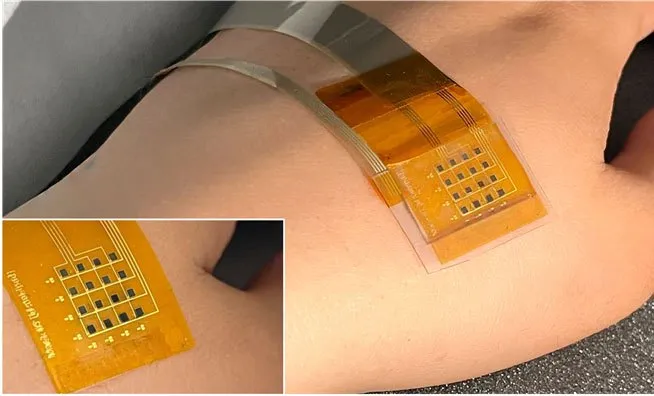
concept image
Experiments showed that the display maintained both visible and NIR output when attached to a curved wrist surface. Under complete darkness, an external NIR light source enabled cameras to capture the reflected patterns. The device also supported NIR pattern recognition under foggy conditions, demonstrating its potential for machine vision in challenging environments.
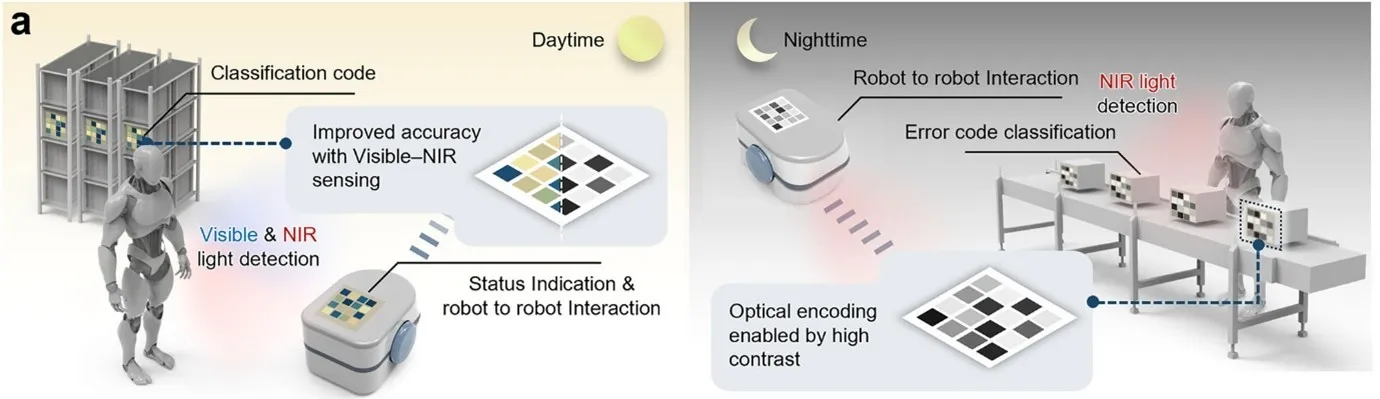
Schematic illustrating the use of a visible/near-infrared dual-band display for information sharing
between humans and robots in bright and dark environments.
The technology could find applications in smart factory labels, wearable electronics, robotic identification, and human-machine interfaces. By separating human-readable and machine-readable information within the same display, it offers a new approach to intelligent manufacturing and Physical AI systems.
However, the current prototype is limited to 16 pixels. Larger arrays will require improvements in driving complexity, pixel crosstalk, manufacturing yield, and long-term durability. Integration with robot vision and control systems also remains a key challenge. Furthermore, the reflective design requires ambient light for visible-color output, while NIR operation depends on an external infrared light source.
The research provides a promising hardware foundation for flexible dual-band displays and more reliable human-machine communication in industrial environments.

