


Summary: Researchers have demonstrated a non-invasive brain-computer interface (BCI) that uses tactile P300 brain signals to control additional robotic limbs while users perform natural movements with both hands. The technology could advance human augmentation, wearable robotics, and next-generation human-machine collaboration without invasive brain implants.
Controlling additional robotic limbs without interfering with natural movement remains a major challenge in human augmentation. Existing approaches often require users to sacrifice control of another body part or struggle to separate artificial control signals from neural activity associated with ongoing movements.
Researchers have developed a tactile P300-based BCI that addresses this challenge using four vibration stimulators positioned on the upper arms and forearms. Through an oddball stimulation paradigm, the system detects P300 signals generated when users selectively pay attention to a particular vibration. Rather than distinguishing four different brain activity patterns, the decoder performs binary classification to determine whether a P300 response is present or absent. The timing of each vibration then identifies the corresponding robotic command.
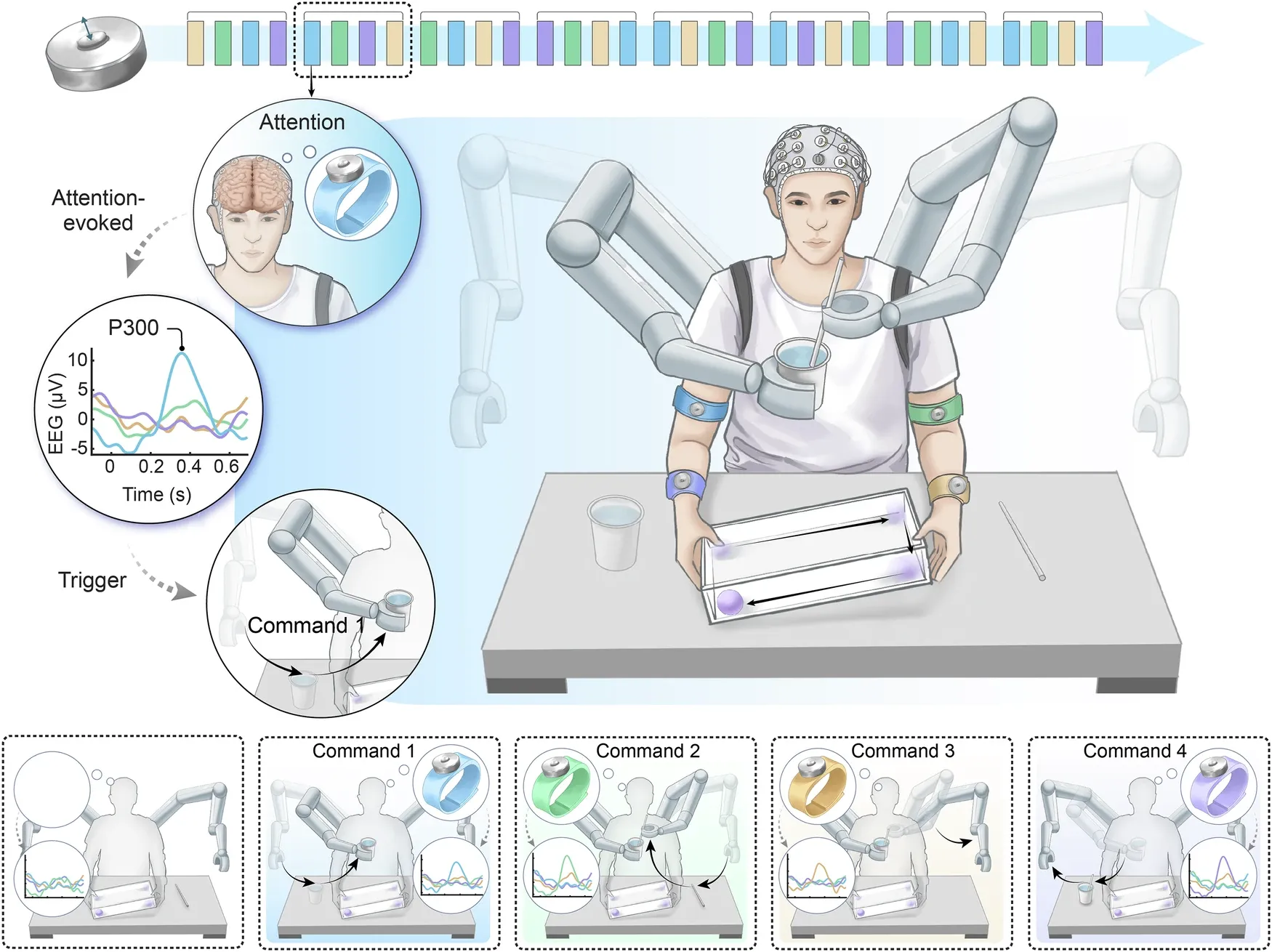
Experimental setup for tactile-encoded brain-computer interface control of supernumerary robotic arms.
P300 is an event-related brain potential associated with attention to unexpected or task-relevant stimuli. By encoding commands through tactile stimulation, the system uses sensory processing pathways rather than relying on motor imagery. This provides a separate neural communication channel that does not directly compete with the brain activity responsible for natural hand movements. It also avoids occupying visual attention, an important advantage when users must simultaneously monitor their surroundings.
The study involved 10 healthy volunteers who completed experiments over three days. Participants performed both BCI-only tasks and dual tasks requiring simultaneous BCI operation and two-handed tray balancing. Dual-task success rates increased from 53.1% on the first day to 69.7% on the third day, approaching the single-task performance of 79.1%. By the final day, the difference between the two conditions was no longer statistically significant.
Importantly, measurements of natural hand coordination showed no significant deterioration during simultaneous BCI operation. The number of attempts required to recognize commands also remained comparable across conditions. Further analysis suggested that training improved the consistency of P300 response timing, helping compensate for movement-related suppression of tactile neural signals.
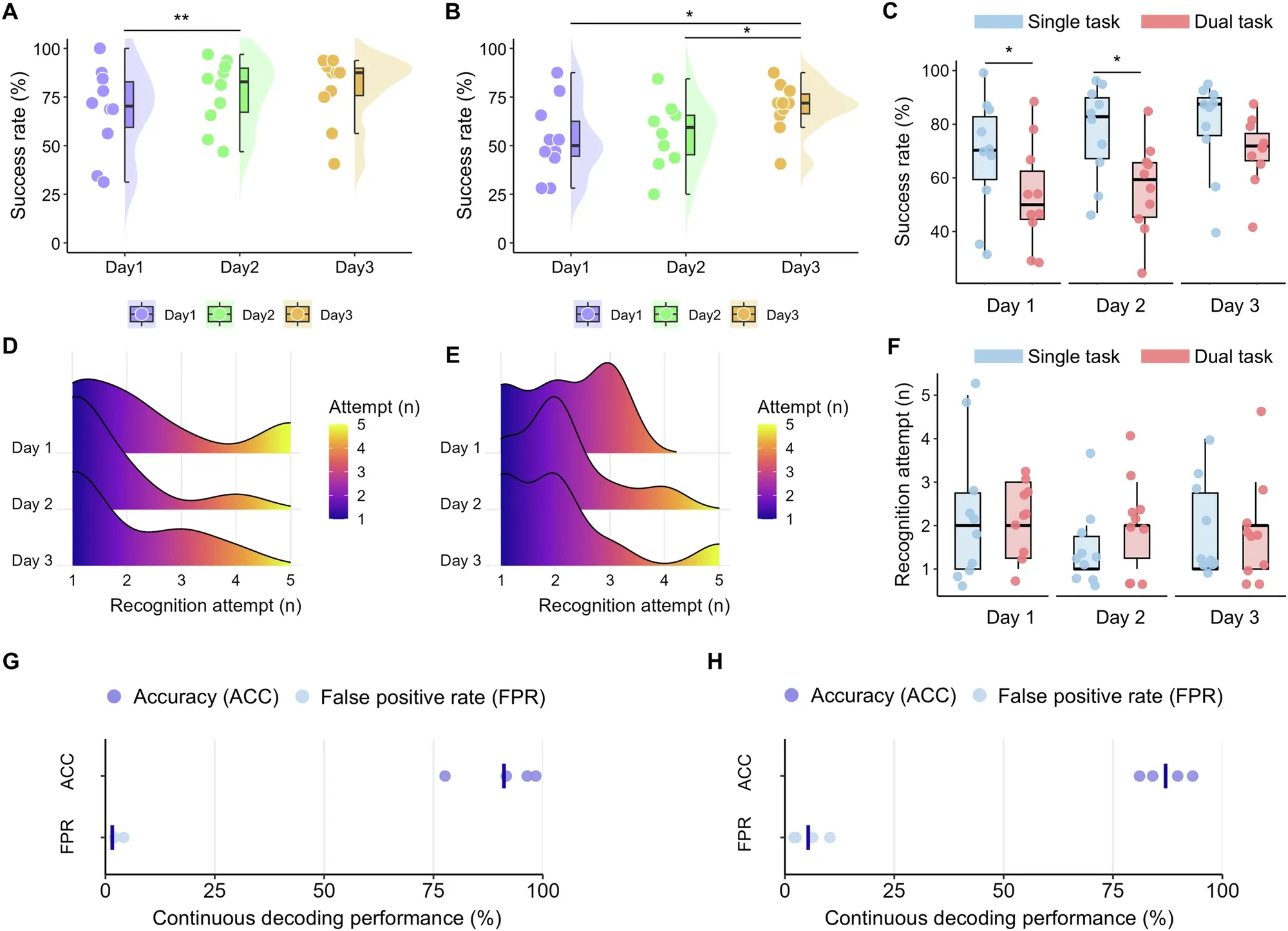
Participant-level online performance of tactile-encoded brain-computer interface over three days of experiment,
comparing single-task and dual-task conditions.
The researchers also demonstrated robotic applications involving object retrieval, coordinated two-arm handoffs, repetitive transfers, and incremental two-dimensional movements. Participants performed these operations while their hands continued independent tasks, illustrating the potential for controlling additional robotic effectors without sacrificing existing motor functions.
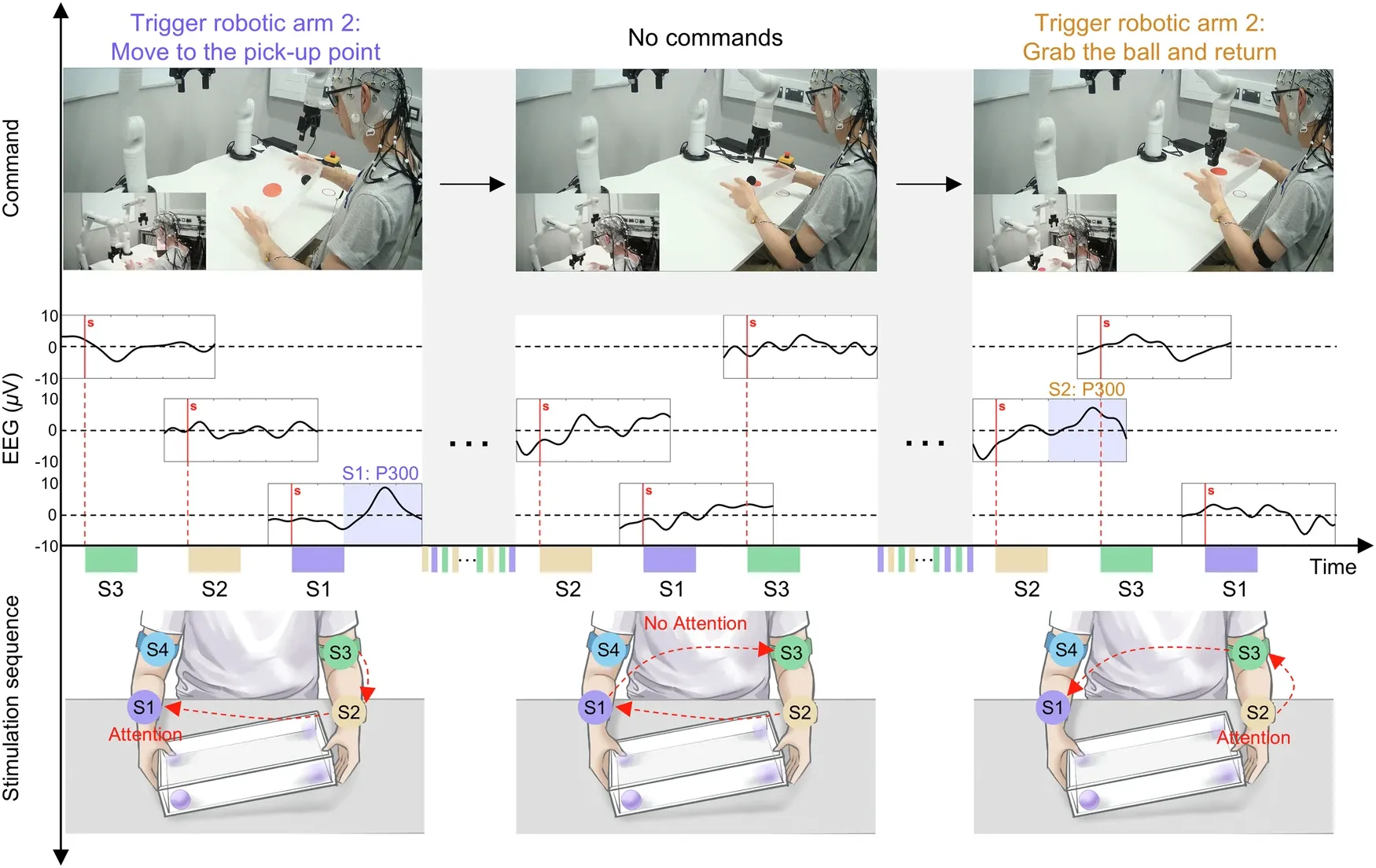 Demonstration of online robotic arm control using tactile-encoded brain-computer interface.
This approach could eventually support industrial workers using extra robotic arms, wearable robotic systems, and assistive technologies that expand human physical capabilities. However, the current system requires multiple stimulation trials, resulting in command delays of several seconds. The robotic arms also followed predefined trajectories rather than supporting continuous proportional control.
Larger studies, faster single-trial decoding, longer training periods, and wearable dry-electrode systems will be necessary to establish real-world usability. Nevertheless, the findings offer a promising direction for non-invasive brain-computer interfaces and a new pathway toward practical human augmentation.

