


Summary: Researchers at University College London (UCL) have developed a halogen-free electrolyte that enables four-electron iodine chemistry in aqueous zinc-iodine batteries. The battery retains approximately 94% of its capacity after 2,000 charge-discharge cycles, offering new potential for safer, long-lasting grid-scale energy storage.
Researchers at University College London (UCL) have achieved a breakthrough in aqueous zinc-iodine batteries, demonstrating stable performance over thousands of charge-discharge cycles. The key innovation is a specially designed electrolyte that stabilizes highly reactive iodine species in water, addressing a major challenge in aqueous battery development: capacity loss during repeated cycling. Unlike conventional lithium-based systems, water-based batteries offer improved safety because their electrolytes are less flammable, making them attractive for large-scale energy storage. However, their relatively low energy density remains a major limitation.
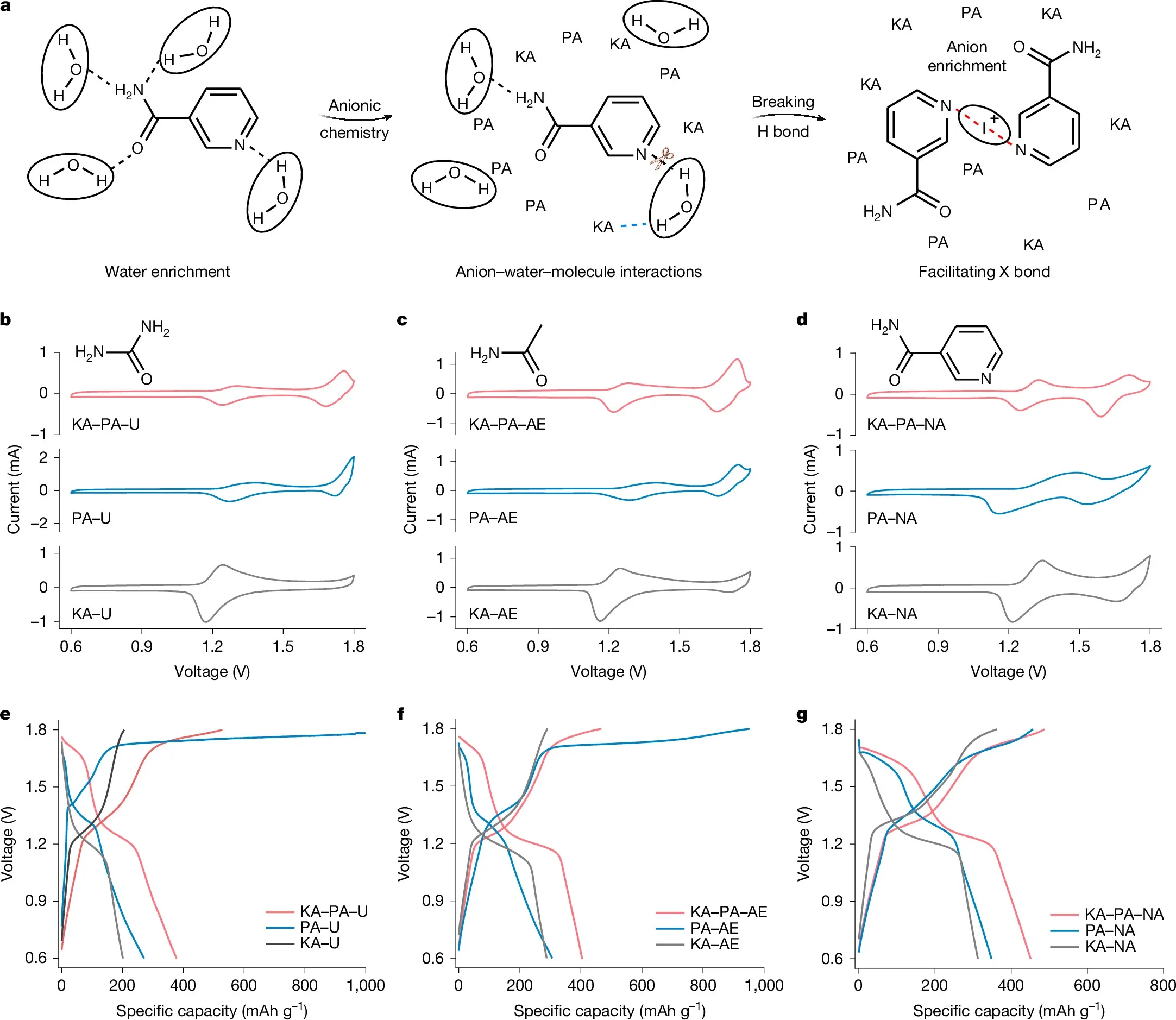 Demonstration of the proposed KA–PA–Nuc electrolyte framework.
The breakthrough lies in increasing iodine's electron transfer from two to four during battery reactions. This four-electron iodine chemistry could potentially double the charge-storage capacity contributed by the same amount of active iodine material, without requiring additional electrode materials. However, highly reactive iodine species generated during the process can readily react with water, causing hydrolysis, active material loss and reduced reaction reversibility. Preventing these unwanted reactions is essential to achieving stable, long-term battery performance.
Previous research attempted to stabilize reactive iodine using highly concentrated, halogen-containing electrolytes. Although effective, these formulations can be corrosive, expensive and difficult to manufacture at scale. The UCL team instead redesigned the electrolyte's local chemical environment, using different components to limit unwanted interactions with water and stabilize reactive iodine species. This halogen-free approach enables reversible four-electron reactions while offering greater flexibility in electrolyte composition.
The researchers tested the technology in both pouch cells and coin cells, demonstrating that the chemistry can operate across different battery formats. Performance tests showed approximately 96% capacity retention after 1,000 cycles at 1 A g⁻¹ and around 94% after 2,000 cycles at 2 A g⁻¹. The electrolyte strategy was also extended to aqueous aluminum-iodine batteries, suggesting broader potential for next-generation aqueous energy storage technologies.
"We are very excited that our new chemistry could bring aqueous batteries closer to commercialization and large-scale deployment. The next steps include testing the technology at a larger scale and improving its performance under real-world operating conditions," said Guanjie He, professor in UCL's Department of Chemistry and corresponding author of the study. Despite the promising laboratory results, further validation is needed to assess large-format battery performance, manufacturing costs and long-term operation under practical conditions. Nevertheless, this halogen-free electrolyte offers a promising pathway toward safer, more durable aqueous batteries for stationary and grid-scale energy storage.

