


Summary: China has commissioned the world's first 300 MW-class artificial hard-rock cavern advanced adiabatic compressed air energy storage (AA-CAES) demonstration project, marking a major breakthrough in large-scale, long-duration energy storage. The project establishes an alternative to conventional salt cavern-based systems, potentially expanding compressed air energy storage deployment in renewable-rich regions worldwide.
On November 16, 2026, China's first 300 MW-class artificial cavern-based advanced adiabatic compressed air energy storage (AA-CAES) demonstration project, known as "Yuan Chu No. 1," was connected to the grid in Yumen, Gansu Province. Included in China's national list of first-of-a-kind major technical equipment, the project marks the emergence of two parallel large-scale development pathways for compressed air energy storage: salt caverns and artificial hard-rock caverns. This development addresses the traditional CAES industry's strong dependence on suitable geological salt formations.
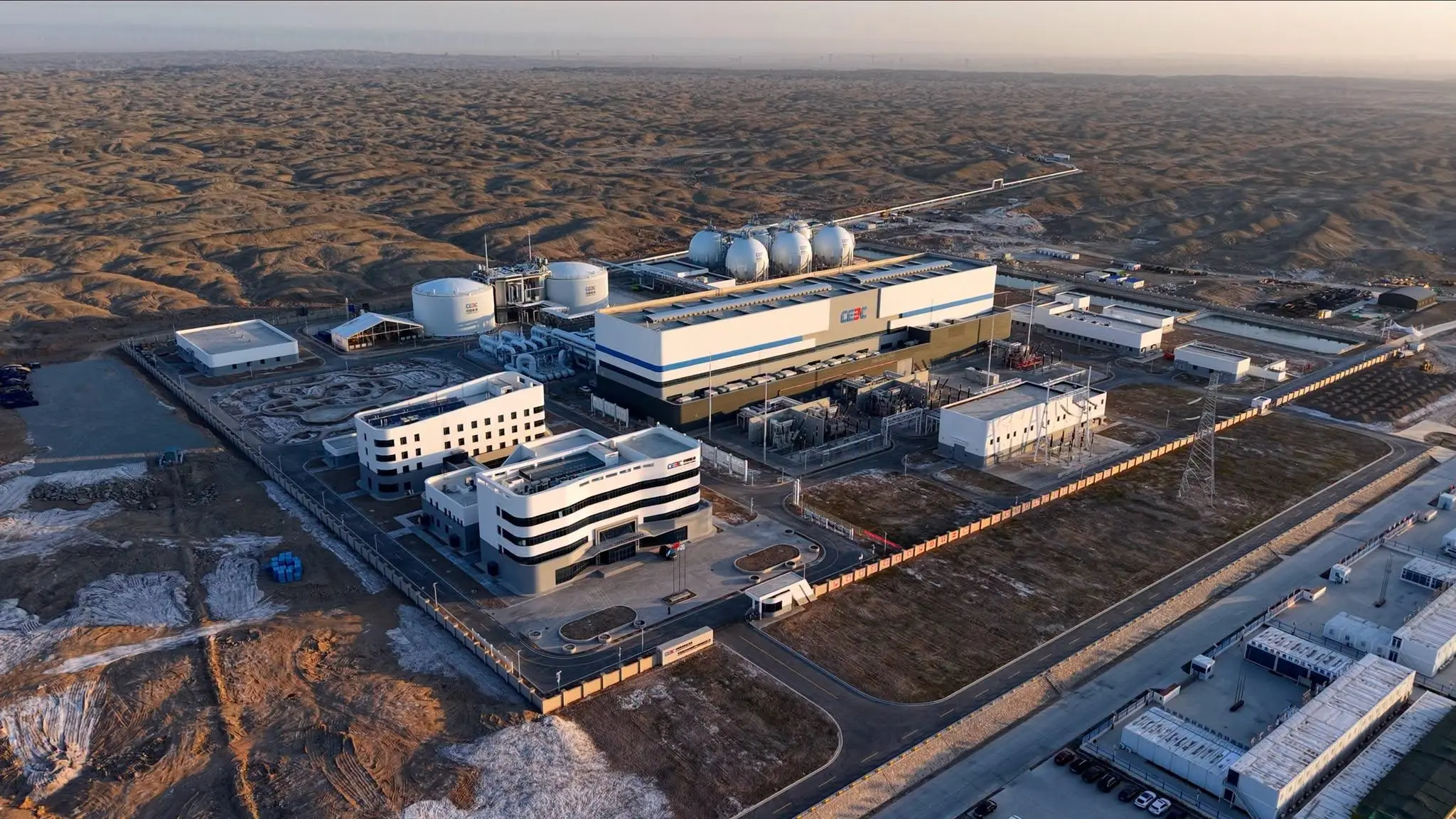
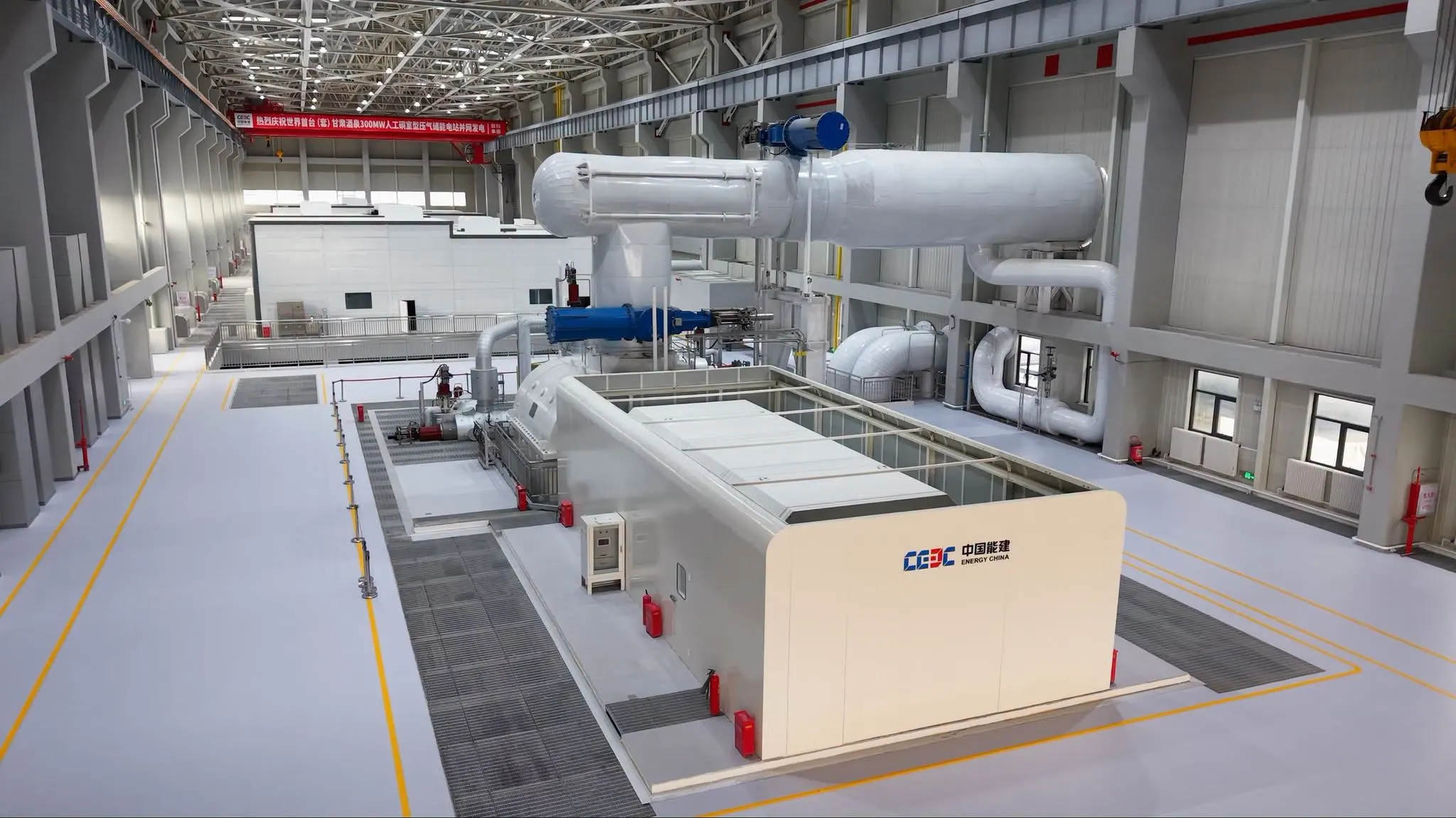
The project was developed and is operated by China Energy Engineering Corporation's Digital Technology Group. It has an installed capacity of 300 MW/1,800 MWh, with an energy storage duration of eight hours and continuous power generation capability of six hours. The underground air storage system is located 110 meters below the surface in solid rock formations. Its four tunnel-shaped caverns have a combined volume of 200,000 cubic meters and a designed operating pressure of 18 MPa. The system achieves an electricity-to-electricity conversion efficiency of 72% and uses an adiabatic, non-combustion architecture, eliminating the need for fossil-fuel-based reheating and resulting in zero carbon emissions during operation. Annual electricity generation is estimated at approximately 600 million kWh.
The engineering team overcame several major technical challenges, including surrounding rock stability and long-term sealing under high internal pressure, heat storage and exchange involving multiple materials across a wide temperature range, and the integration of shared heat-exchange systems for both charging and discharging. The project also fills a gap in comprehensive engineering standards for the surveying, design, construction, and operational control of artificial cavern-based CAES systems.
From a global industry perspective, overseas CAES commercialization has historically focused on salt cavern-based systems that rely on fuel combustion for reheating. Benchmark power plants such as Germany's Huntorf facility and the United States' McIntosh plant both utilize natural salt formations and natural gas for thermal replenishment, achieving round-trip efficiencies of only 42%–54%. Canada's Hydrostor and most planned projects in Europe have also prioritized salt cavern solutions. Research into artificial cavern-based systems in Europe, the United States, South Korea, and Switzerland has largely remained at the megawatt scale or below. Challenges involving rock mass impermeability, long-term pressure stability, and large-scale integrated thermal storage and exchange have prevented these technologies from reaching the 100 MW level or establishing a comprehensive equipment supply chain.
China's CAES industry has already completed two generations of technological validation. The "Energy Storage No. 1" project in Yingcheng, Hubei Province, was an early demonstration of the large-scale potential of salt cavern-based AA-CAES. However, salt resources are geographically concentrated and often poorly aligned with the northwestern regions where wind and solar resources are abundant, particularly large-scale renewable energy bases in desert, Gobi, and barren-land areas.
Yuan Chu No. 1 establishes the artificial hard-rock cavern pathway, eliminating the need for naturally occurring underground storage cavities. Site selection is primarily determined by rock mass integrity and hydrogeological conditions, allowing projects to be developed closer to major wind and solar power bases and supporting integrated renewable energy generation and storage. The two pathways offer complementary advantages: salt cavern systems benefit from lower civil engineering costs and the natural self-sealing properties of surrounding rock, while artificial cavern systems provide greater site-selection flexibility and are particularly suitable for renewable energy bases across northern, northeastern, and northwestern China. Together, they form a distinctive and diversified CAES technology portfolio.
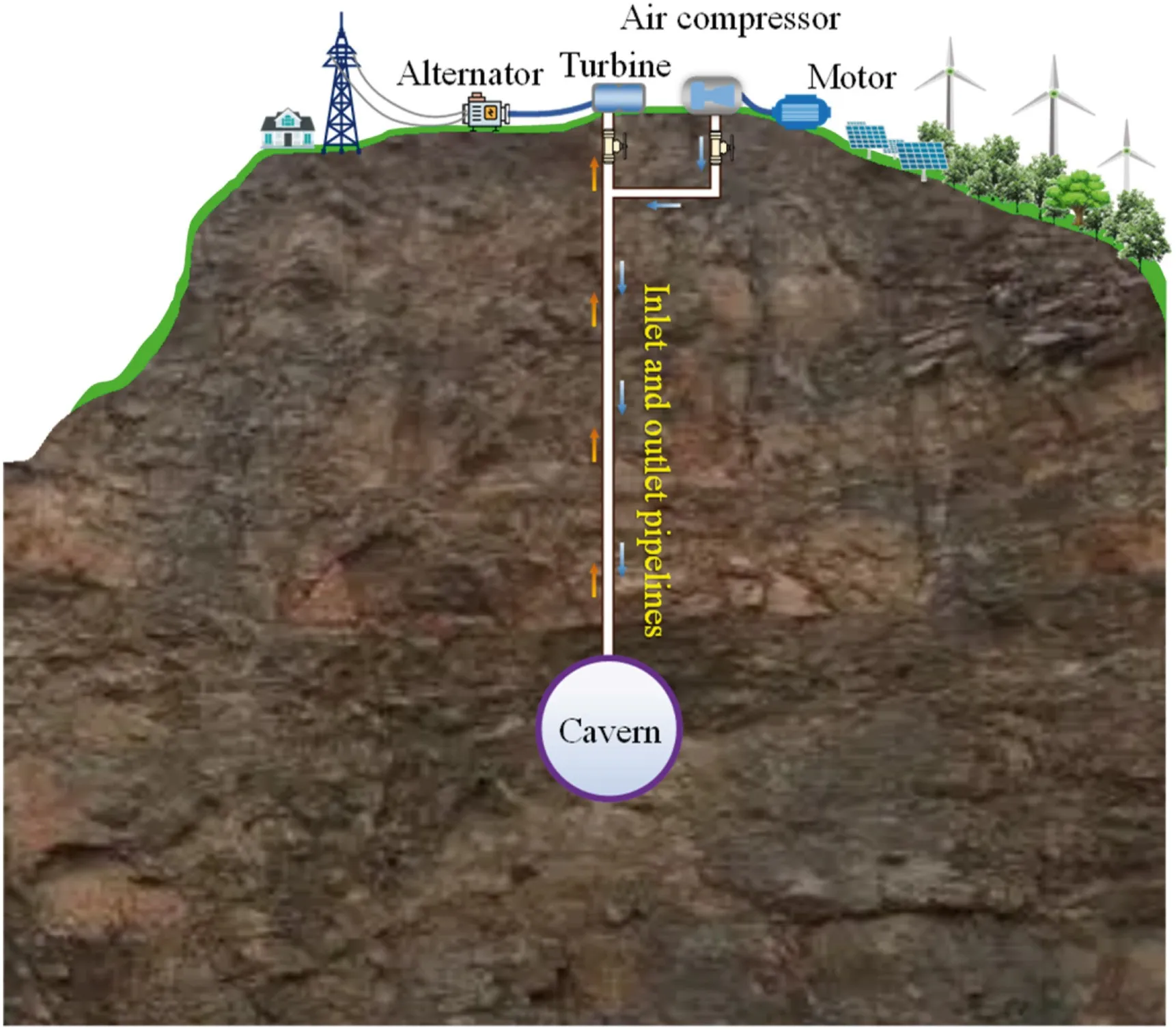
The commissioning of this project represents a significant development for the long-duration energy storage sector. Pumped hydro storage is constrained by geographical and topographical requirements, while electrochemical energy storage faces challenges involving resource availability, service life, and safety. Flow batteries and gravity-based storage technologies are still undergoing large-scale commercialization validation. Artificial cavern-based AA-CAES offers long service life, large unit capacity, and suitability for multi-day energy balancing, further strengthening China's position across the value chain of 100 MW-class adiabatic compressed air energy storage. It also creates opportunities for equipment standardization and future cost reductions.
Nevertheless, the technology still faces several practical constraints. Artificial cavern construction involves substantial civil engineering work, resulting in higher initial investment than salt cavern alternatives. Its economic viability is sensitive to geological conditions and electricity pricing mechanisms. Long-term monitoring data on cavern sealing performance, surrounding rock creep, and potential leakage must also be accumulated over several years. Furthermore, its 72% round-trip efficiency remains below that of mature pumped hydro storage systems. Future development is expected to focus on advanced sealing liners, high-temperature thermal storage materials, improved equipment efficiency, and modular cavern design.
Overall, Yuan Chu No. 1 represents more than an isolated technological breakthrough. It marks a transition in compressed air energy storage from a resource-dependent technology toward a more flexible, strategically deployable energy storage solution. As global demand for long-duration energy storage continues to grow, the project addresses a key gap in energy storage solutions for northwestern China's large-scale renewable energy bases. Together with pumped hydro, salt cavern-based CAES, and flow batteries, artificial cavern-based AA-CAES will contribute to a more diversified long-duration energy storage ecosystem while providing a practical engineering reference for developing compressed air energy storage in hard-rock regions worldwide.

