


Summary: Researchers at the Korea Advanced Institute of Science and Technology (KAIST) have developed flexible lithium-sulfur battery electrodes based on nickel-cobalt selenide nanowires, enabling energy storage to be integrated directly into curved structural components such as drone landing gear and robot frames. The electrodes remain stable after 1,000 bending cycles, potentially reducing system weight while improving the endurance and payload capacity of drones and robots.
In the future, drone landing gear could serve two purposes: supporting the aircraft while also storing electrical energy. Researchers at the Korea Advanced Institute of Science and Technology (KAIST) have developed a nanowire-based lithium-sulfur battery electrode that brings structural energy storage a step closer to practical applications. The electrode maintains stable performance even after 1,000 bending cycles.
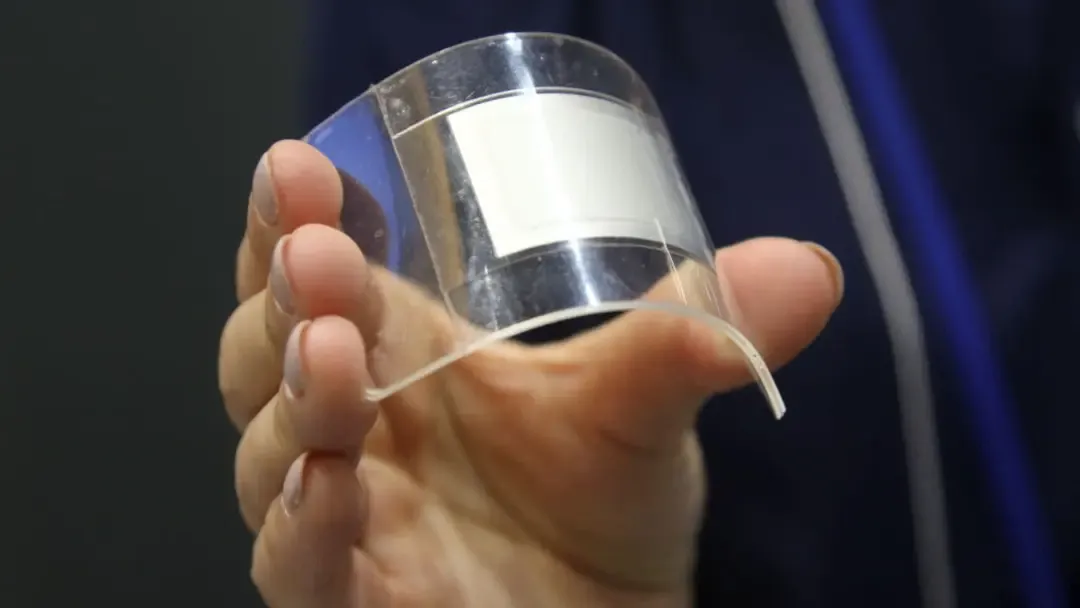
Representative image of flexible lithium battery.
In conventional devices, batteries and structural frames are separate components. Batteries require dedicated packaging, taking up valuable space and adding weight. The new approach integrates energy storage directly into structural components, allowing curved drone landing gear and robot frames to function as batteries. This could reduce overall system weight and create additional capacity for heavier payloads and longer operating times.
The key innovation lies in growing nickel-cobalt selenide (NiCo₂Se₄) nanowires directly onto a woven carbon cloth substrate to create a flexible electrode. This structure can conform to complex curved surfaces while maintaining good electrical conductivity during repeated bending.
Previous structural battery designs have largely been limited to flat configurations, making them difficult to incorporate into hollow or curved components. Rather than simply coating active materials onto a flat substrate, the KAIST team anchored nanowires firmly to the interconnected carbon fibers. This approach addresses a major challenge in flexible electrodes: coating cracks, material detachment, and electrical disconnection caused by repeated mechanical deformation.
The researchers selected lithium-sulfur chemistry for the battery system because of its high theoretical energy density and lightweight characteristics. The nickel-cobalt selenide nanowires serve two important functions. First, they help compensate for sulfur's inherently poor electrical conductivity. Second, they capture soluble lithium polysulfides generated during charge and discharge, helping mitigate performance degradation and improve battery stability.
Test results demonstrate the electrode's mechanical durability. It maintained its structural integrity after 1,000 bending cycles at a bending radius of just 2.5 millimeters, with no observable nanowire detachment or damage.
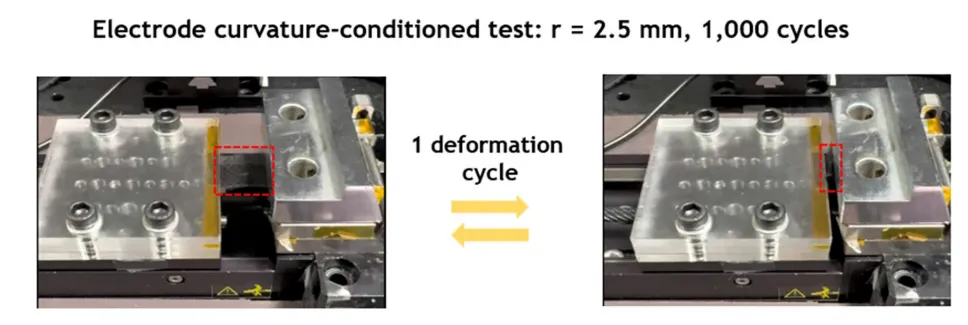
Curvatureconditioning test setup using a bending radius of 2.5 mm for 1,000bending-release cycles.
The team subsequently fabricated pouch-type lithium-sulfur batteries using the flexible electrodes and integrated them into different structural designs, including elliptical and rectangular components, as well as structures resembling drone landing gear. All configurations successfully powered LEDs, demonstrating the feasibility of integrating batteries into non-planar structures.
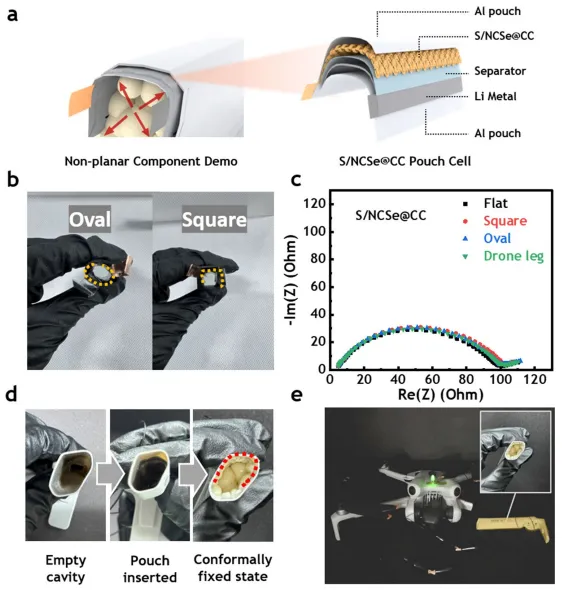
Proof-of-conceptgeometry-constrained fixationin diverse hollow structuralcomponents with different geometries.
Even more notably, the researchers conducted tests under extreme mechanical conditions. When an external cylindrical structural frame was fractured by an applied force, the battery retained 99.8% of its initial voltage. The connected LED continued emitting light without interruption or flickering, indicating that the energy-storage component could maintain its electrical function even after damage to the surrounding structure.
"Drones and robots contain many curved and hollow components, so it is essential for batteries to operate reliably when integrated into these structures,” said Professor Il-Kwon Oh, who led the research. “Our study demonstrates the potential for drone legs and robotic frames to serve not only as structural components but also as energy storage systems.”
According to the researchers, the technology could eventually be combined with lightweight composite materials to enable the mass production of structural components that provide both mechanical support and energy storage. Such components could help reduce the weight of drones and robots while freeing up additional space for payloads and other onboard systems.
However, further development and testing will be necessary before the technology can be commercialized. In particular, the team still needs to quantify the actual weight reductions and improvements in operating endurance achievable through structural battery integration.
The findings have been published in Advanced Composites and Hybrid Materials.

