


Summary: Tesla has unveiled Powercore, a 7.4 MW solid-state transformer (SST) platform integrating medium-voltage power conversion, grid-forming inverter technology and solid-state circuit protection. Designed for utility-scale energy storage, solar farms and AI data centers, the system aims to simplify grid connections, improve conversion efficiency and support next-generation 800 V DC power infrastructure.
LAS VEGAS, November 17, 2026 — Tesla has introduced Powercore, a new solid-state transformer (SST) power electronics platform, at the RE+ 2026 clean energy exhibition in Las Vegas. Designed to work directly with Tesla's Megapack utility-scale battery storage systems, the integrated platform combines a medium-voltage transformer, grid-forming inverter and solid-state circuit breaker in a single cabinet.
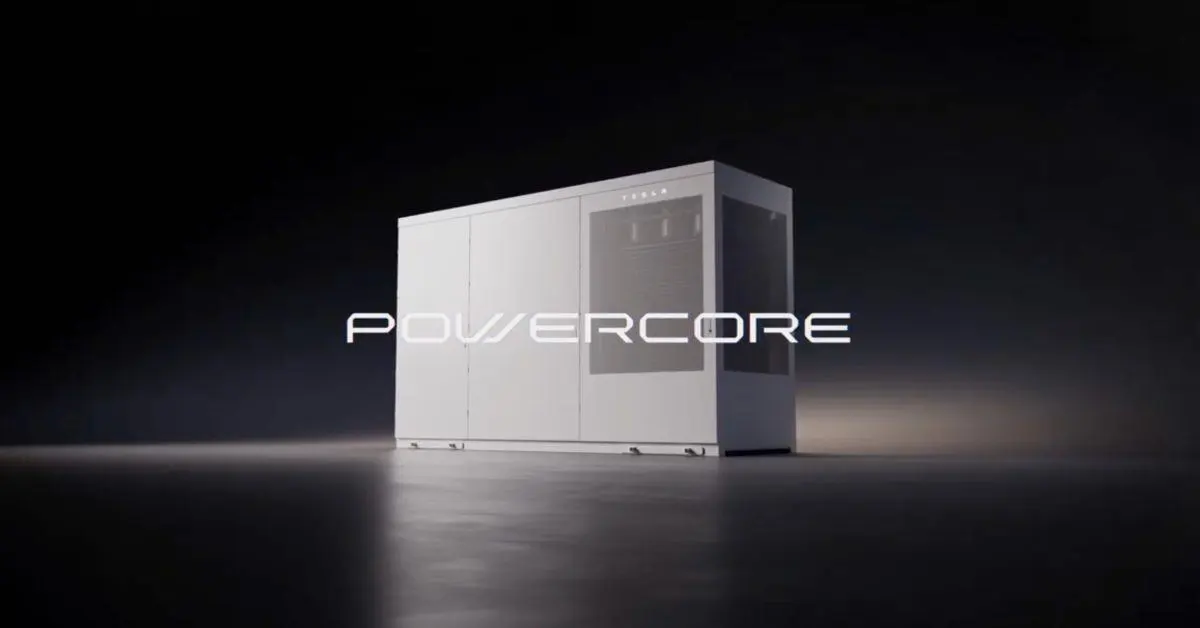
Powercore delivers a continuous output of 7.4 MW (9 MVA) at 34.5 kV AC, with a grid-forming peak capacity of 10 MVA. It supports AC voltages from 10 kV to 34.5 kV and DC input voltages from 800 V to 2,000 V, accommodating both existing 1,500 V solar installations and emerging 2,000 V DC architectures.
According to Tesla's specifications, the platform achieves peak power conversion efficiency of 98.86% and operates across temperatures ranging from -40°C to 55°C. It is also designed for a service life supported by warranties of up to 25 years, with guaranteed system availability of at least 99.9%.
The specifications
| Continuous power | 9 MVA (7.4 MW) at 34.5kV |
| Peak power, grid-forming | 10 MVA |
| AC side | 10kV to 34.5kV |
| DC side | 800 V to 2,000 V |
| Peak efficiency | 98.86% |
| Breaker | Solid-state, clears faults up to 1,000 times faster than a conventional one |
| Operating temperature | −40 °C to 55 °C |
| Warranty | Up to 25 years |
| First units operating | 2027 |
Ultra-Fast Protection and Modular Architecture
A key feature of Powercore is its integrated solid-state circuit breaker, which can interrupt electrical faults in approximately 100 microseconds. This is around 1,000 times faster than conventional mechanical circuit breakers, helping limit fault propagation and improve system protection.
The platform uses silicon carbide (SiC) power semiconductors and an oil-free architecture. Unlike conventional oil-filled transformers, this design eliminates the fire risks associated with transformer insulating oil. Its modular construction also allows individual modules to be replaced on-site without removing the entire cabinet, potentially reducing maintenance time and operational disruptions.
Direct Integration with Megapack and Megablock
Traditional utility-scale power systems often rely on multiple separate components, including inverters, low-voltage transformers and switchgear. These stages add complexity, increase conversion losses and require more installation work.
Powercore is designed to simplify this architecture by enabling bidirectional power conversion between medium-voltage AC and high-voltage DC. It connects directly to the DC bus of Tesla's Megapack and Megablock storage systems, reducing the number of conversion stages and simplifying electrical integration for large-scale energy storage projects.
Beyond battery storage, Tesla is targeting utility-scale solar installations, high-power EV charging infrastructure and AI data centers. The company is working with NVIDIA to pursue DSX Ready certification, with the goal of supporting direct 800 V DC power delivery to AI computing clusters. This could reduce the need for additional power conversion stages within hyperscale data centers, where increasing AI workloads are driving demand for more efficient and higher-capacity power infrastructure.
U.S. Manufacturing and 2027 Deployment
Tesla has confirmed that Powercore will be manufactured in the United States, with commercial units expected to enter operation in 2027. The company has not yet disclosed pricing or initial customer details.
The launch represents Tesla's formal move into the solid-state transformer market, extending its energy infrastructure portfolio beyond battery storage into medium-voltage power conversion and grid integration. As electricity demand from AI data centers, renewable energy and electrified transportation continues to grow, platforms such as Powercore could become an important component of next-generation grid infrastructure.

