


Summary: Researchers have developed a halogen-free KA–PA–Nuc electrolyte system that enables reversible four-electron iodine redox reactions in aqueous batteries, doubling the theoretical capacity of iodine cathodes. The technology eliminates highly corrosive halogen-based electrolytes, offering a promising pathway toward safer, lower-cost, long-duration energy storage for solar and wind power.
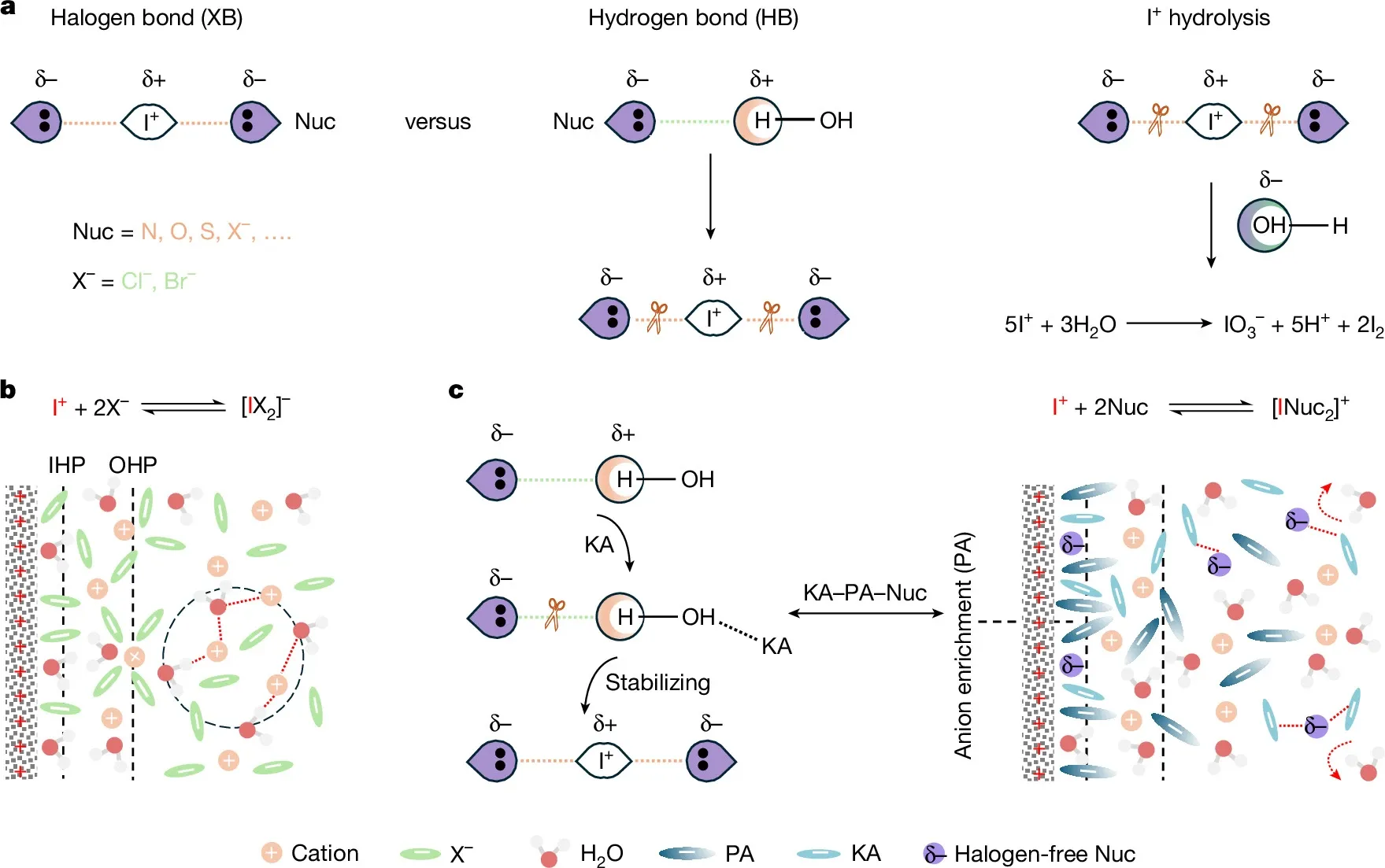
Comparisons of mechanistic frameworks for four-electron iodine conversion in aqueous electrolytes.
As solar and wind power generation continues to expand, energy storage systems are becoming increasingly important for balancing intermittent electricity supply and demand.
Conventional lithium-ion batteries face challenges involving lithium prices, supply chain constraints, and thermal runaway risks, creating cost pressures for utility-scale energy storage.
Aqueous zinc-iodine batteries have emerged as a promising alternative because zinc and iodine are abundant and the batteries are inherently safer. However, their development has long been constrained by two major limitations.
First, conventional systems can only utilize iodine's two-electron redox reaction, resulting in relatively low energy density. Second, accessing the higher-capacity four-electron reaction has been difficult because high-valence iodine species are highly susceptible to hydrolysis.
Previous approaches relied on highly concentrated chlorine- or bromine-containing electrolytes to stabilize these species. However, their strong corrosiveness increases material requirements, manufacturing costs, and maintenance expenses.
The new research moves beyond conventional halogen-complexation strategies by using coordinated anion regulation to control the electrode-interface microenvironment.
Polar anions create a water-depleted, anion-rich interfacial layer on the electrode surface, reducing the exposure of high-valence iodine species to water molecules.
Meanwhile, penetration-promoting anions weaken hydrogen bonding between water and nucleophilic molecules. This allows nucleophilic compounds such as urea and nicotinamide to form stable halogen bonds with I⁺ species, suppressing hydrolysis and enabling stable, reversible four-electron iodine redox reactions.
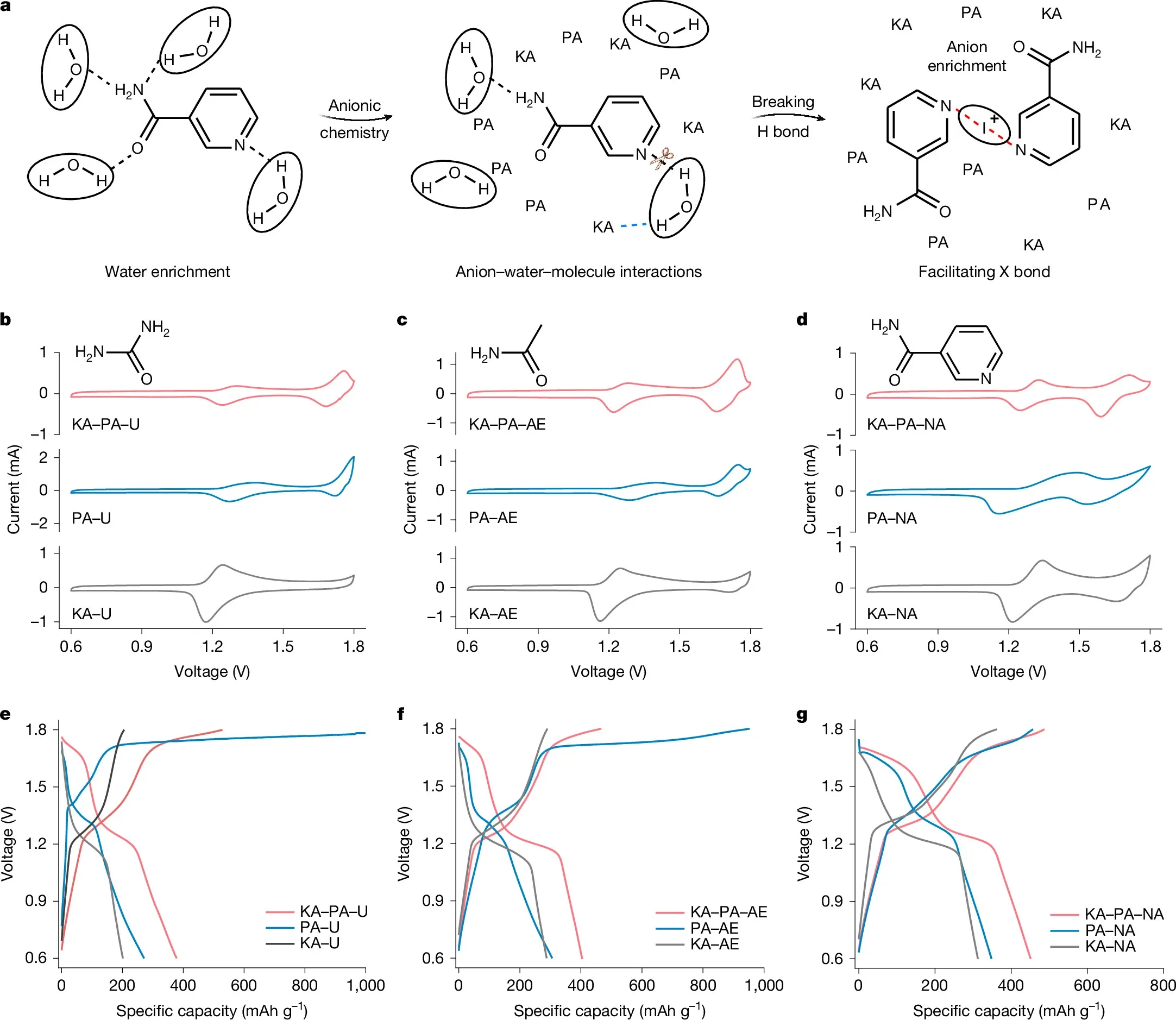 Demonstration of the proposed KA–PA–Nuc electrolyte framework.
The experimental results are promising. Zinc-iodine batteries maintained 96% of their initial capacity after 1,000 cycles at a current density of 1 A/g.
At 2 A/g, they retained 94% capacity after 2,000 cycles. The iodine areal loading reached up to 12.2 mg/cm², demonstrating potential for the high active-material loading required by practical energy storage batteries.
The research team also successfully fabricated a 1.1 Ah pouch cell, demonstrating progress beyond laboratory-scale testing. In addition, the electrolyte design is compatible with aluminum-iodine battery systems, potentially broadening its applications.
The technology offers several potential advantages for commercial energy storage. As aqueous batteries, zinc-iodine systems have a lower fire risk than conventional organic-electrolyte lithium-ion batteries.
Eliminating corrosive halogen salts could also allow manufacturers to use more conventional and affordable current collectors and battery casings, reducing corrosion-protection requirements and long-term maintenance costs.
With zinc and iodine both widely available, the technology could reduce dependence on lithium resources and support the deployment of large-scale battery energy storage systems for integrating intermittent solar and wind power into electricity grids.
The technology remains at the laboratory prototype stage, and further engineering work is needed to address challenges such as the loss of active iodine material under high-loading conditions.
Nevertheless, the findings demonstrate a viable approach to halogen-free four-electron iodine energy storage and introduce a new electrolyte-design strategy for next-generation low-cost, long-duration energy storage batteries.
In the future, the technology could find applications in commercial and industrial energy storage, as well as utility-scale renewable energy storage projects.

